Executive Functions vs Moral Reasoning
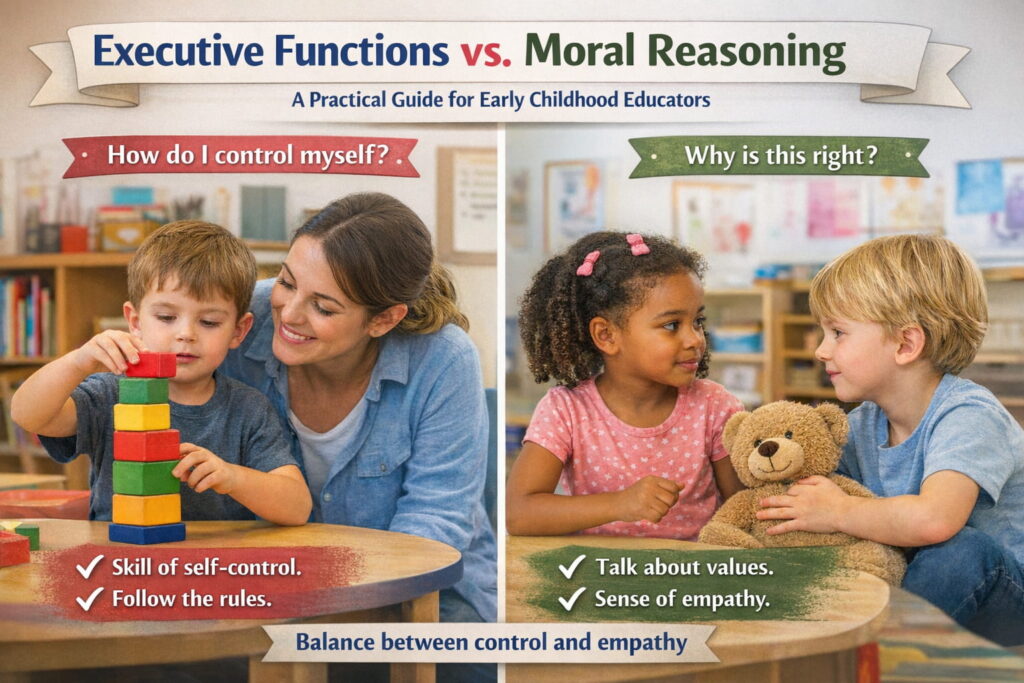
Short version: Executive functions (EF) help children do things—control impulses, remember instructions, and switch tasks. Moral reasoning helps children understand why some actions are right or wrong. In kindergarten, we need to grow both. One builds the child’s self-control toolbox; the other builds their inner compass.
This post explains the difference in simple language, gives many classroom examples, and shares practical activities you can use tomorrow.
What are Executive Functions (EF)?
Executive functions are the brain skills that help children manage themselves and their actions. Think of EF as the child’s workbench or toolkit.
Key skills and simple examples:
- Inhibitory control (self-control) — waiting for a turn, not grabbing a toy. Example: a child holds back from shouting out an answer and instead raises their hand.
- Working memory — holding information in the mind while using it. Example: remembering a two-step instruction: “Put the red block in the basket, then bring me a book.”
- Cognitive flexibility — switching between ideas or plans. Example: changing from a painting activity to tidy-up time without a meltdown.
Why EF matters in class: children with stronger EF find it easier to follow routines, focus on group activities, and solve simple problems.
Classroom activity for EF:
- Red Light / Green Light with rules: add a rule (e.g., when the leader says “purple”, children must hop), so kids must hold the rule in mind and wait to act.
What is Moral Reasoning?
Moral reasoning is how children think about what is fair, kind, or right. It is the compass that guides their choices, not just the brakes or gears.
Simple examples:
- A child sees a friend crying after being pushed. Moral reasoning is the child thinking: “Pushing hurts — I should help.”
- Another child might know that taking a toy is “not allowed” but asks: “But what if nobody needs it?” Moral reasoning helps weigh feelings and reasons.
Moral reasoning grows with talk, relationships, and experience. It uses feelings (empathy), stories, rules, and chances to practice decisions.
Classroom activity for moral reasoning:
- Story-based dilemmas: read a short story where a character makes a tricky choice, then ask children “What would you do? Why?” Encourage several answers and respect differences.
Side-by-side examples (how they look in real life)
- Playtime dispute over a truck
- EF skill: The child waits for their turn because they remember the rule.
- Moral reasoning: The child offers the truck because they think sharing makes their friend happy.
- Cleaning up after painting
- EF skill: The child remembers the clean-up steps and follows them.
- Moral reasoning: The child joins in because they believe everyone should care for shared space.
- Saying sorry after a push
- EF skill: The child stops, takes a breath, and remembers to use words instead of hitting.
- Moral reasoning: The child understands that pushing hurts and says sorry from empathy.
Notice: a child can have one skill without the other. A child may follow rules (strong EF) but not understand fairness (less moral reasoning), or feel bad but not be able to stop themselves (empathy without EF).
Why we must teach both
- EF without moral reasoning may produce obedient kids who follow rules but don’t reflect on why rules exist.
- Moral reasoning without EF may produce kind children who want to do good but struggle to control impulses.
Our job is to help children become both capable and compassionate.
Practical strategies and activities (ready for the classroom)
To strengthen executive functions
- Short games with rules: Simon Says, Freeze Dance, Red Light / Green Light with variations.
- Step-by-step tasks: puzzles, Lego builds with simple sequential instructions.
- Visual schedules: show children the sequence of the day (helps working memory and transitions).
To grow moral reasoning
- Circle-time dilemmas: one small dilemma per week; let children suggest solutions and reasons.
- Emotion-naming and perspective-taking: say, “Anna looks sad because her tower fell. How would you feel?”
- Classroom responsibilities: rotating roles (helper of the day) to practice care and fairness.
Combine both in the same activity
- Role-play clean-up with choices: give children a scenario: some toys are missing. Ask: “What can we do?” They must plan (EF) and choose a fair solution (moral reasoning).
- Conflict-resolution steps: teach a 3-step routine—Stop & breathe (EF), listen to the other person (EF + empathy), agree a fair fix (moral reasoning).
A simple one-week mini-plan (for a group of 3–6 year olds)
Monday: Simon Says (EF); Story: “Tom and the Missing Crayon” (moral talk).
Tuesday: Puzzle challenge in pairs (EF); practice saying feelings: “I feel… when…” (moral reasoning).
Wednesday: Visual schedule review and tidy race (EF); circle talk: ‘‘What is fair?’’ (moral reasoning).
Thursday: Role-play: sharing toys (combined).
Friday: Reflection circle: children say one thing they did to help a friend this week (builds moral identity).
Tips for teachers and parents
- Name the skills aloud. Say: “You waited so well—that’s your self-control,” or “You helped—this shows kindness.” Naming builds awareness.
- Keep language simple. Use “fair,” “helps,” “hurts,” not abstract moral words.
- Model both. Show calm control when upset (EF) and explain why you chose to help or forgive (moral reasoning).
- Celebrate small steps. Growth is slow; praise effort more than perfection.
Final thought
Executive functions are the child’s ability to act well. Moral reasoning is their ability to want to act well for good reasons. In kindergarten, we shape both. When children learn to stop, think, and choose with care, they grow into capable, kind people.


Klavdija Svet, author of Elevate to Educate
Elevate your teaching skills and stay ahead of the curve! Receive our monthly Insights, packed with professional development opportunities, classroom inspiration, and the latest trends in education. Don’t miss out on the chance to take your teaching to the next level. Subscribe now!