Staying Calm So Children Can Find Calm: Conscious Co-Regulation for Early Childhood Educators
When a child falls apart, your calm becomes their anchor
It is late morning. A four-year-old’s tower has just collapsed, and so has she. She is screaming, hitting the floor, and three other children have stopped playing to watch. You feel your own heart rate rise. Somewhere inside, a voice says: make it stop, now.
Every early childhood educator knows this moment. What happens next depends less on the child than on you.
Researchers describe what skilled educators do here under several names: co-regulation, affect attunement, and containment. The shared idea is simple and powerful. You consciously regulate your own emotional state, voice, and body so that the child’s distress can settle, rather than letting the child’s distress raise yours. We can call this conscious modulation: not suppressing what you feel, but choosing what you offer.
The good news is that this is not a personality trait. It is a professional skill, and like every skill, it grows with practice.
Why children borrow our nervous system
Young children cannot yet calm themselves reliably. The brain regions that support self-regulation, especially the prefrontal cortex, mature slowly across childhood and into adolescence. Until then, children regulate largely through the adults around them.
When a child is overwhelmed, your state becomes their reference point. A steady, warm adult signals safety, and the child’s body can begin to settle. An alarmed, irritated, or rushed adult signals danger, and the distress tends to grow.
This is why the conscious part matters so much. Our automatic reaction to a screaming child is often stress or the urge to stop the noise. Conscious modulation means noticing that reaction, and then deliberately choosing a different response.
Six practices you can bring into your group tomorrow
1. Regulate yourself first
Before you respond, take one or two seconds to notice your own state: tight shoulders, a sharpening voice, the urge to fix or stop the crying immediately. One slow exhale, softened shoulders, or a brief pause is often enough to move you from reacting to responding. Everything else rests on this step.
2. Let your voice and body do the talking
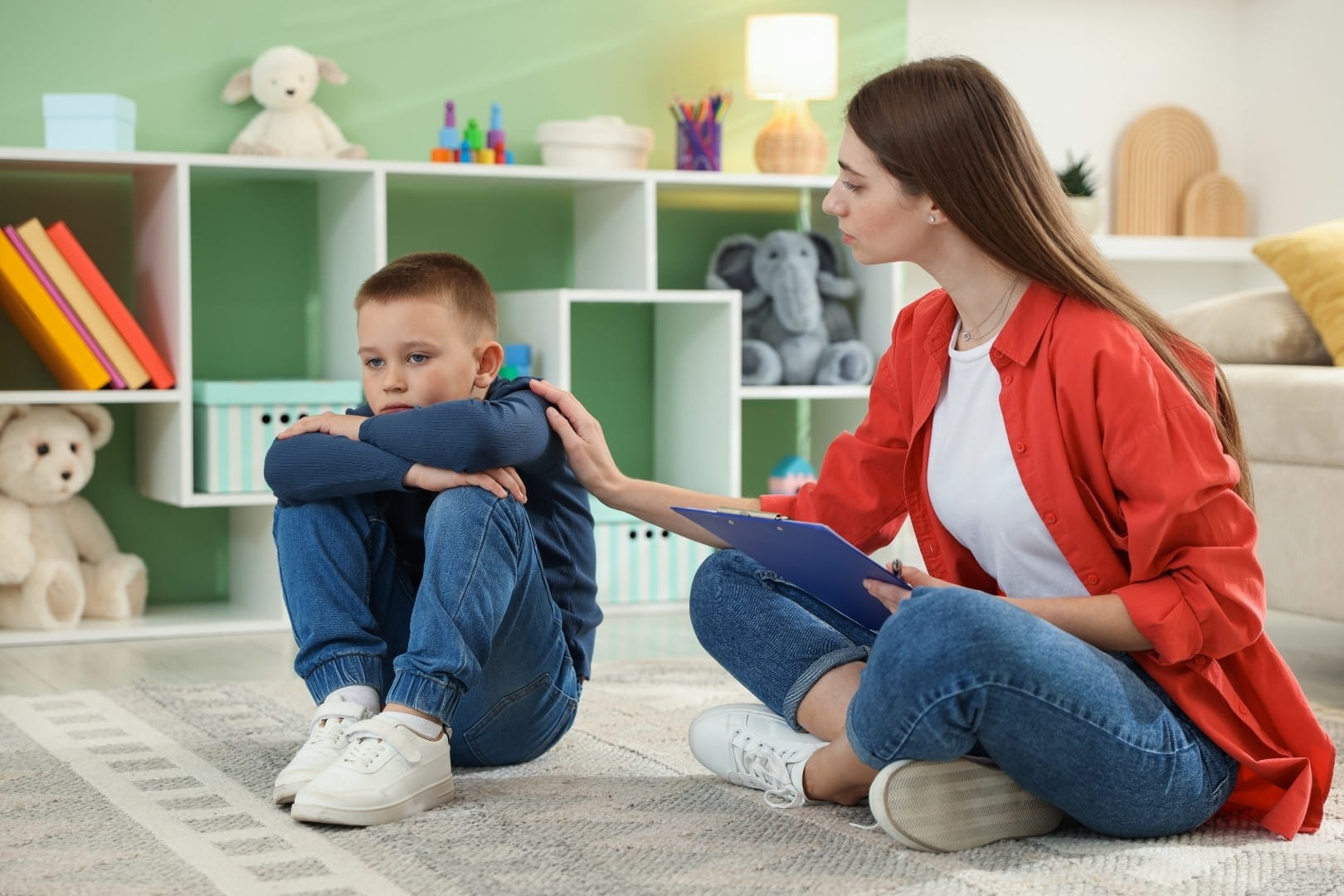
In the peak of distress, children read how you are present far more than what you say. Lower and slow your voice. Kneel or sit at the child’s eye level, slightly to the side rather than looming in front. Keep your face soft and your hands relaxed. Your body is saying: you are safe, and I am not going anywhere.
3. Meet them, then lead them (attunement)
Developmental psychologist Daniel Stern described affect attunement: the adult reflects the child’s emotional intensity so the child feels understood, then gradually brings it down. You might begin with some energy (“Oh, that was SO frustrating!”) and then let your voice become softer and slower. The child follows you from high arousal toward calm.
4. Mirror the feeling, but clearly as their feeling
Researchers György Gergely and John Watson described marked mirroring. The adult shows empathy for the child’s fear or anger without becoming frightened or angry themselves. The child learns something profound: this feeling belongs to me, someone understands it, and it can be managed.
5. Be a container
Psychoanalyst Wilfred Bion described the caregiver as a container. You receive the child’s overwhelming feelings, tolerate them without collapsing or retaliating, and return them in a more manageable form, usually through calm presence and a few simple words. You don’t have to solve the feeling. You only have to be big enough to hold it for a while.
6. Name it, once the storm begins to pass
When the child is a little calmer, put the emotion into words: “You worked so hard on that tower, and it fell. You’re really disappointed.” A neuroimaging study led by Matthew Lieberman (2007) found that labeling emotions reduced activity in the amygdala, a brain region involved in threat responses. Daniel Siegel and Tina Payne Bryson popularized this as “name it to tame it.” John Gottman’s research on emotion coaching similarly found that adults who acknowledge and name children’s feelings support children’s emotional regulation over time.
One child in distress, a whole group watching
Parents usually co-regulate one child at a time. Educators rarely have that luxury. While you support one child, others are watching, and emotions spread through a group. Psychologists call this emotional contagion. The encouraging side is that calm is contagious too: when the children see you stay steady, the whole room learns that big feelings are survivable.
A few ways to make this work in a group setting:
- Agree on roles with your colleagues in advance. Decide together who stays with the distressed child and who keeps the rest of the group engaged. A quiet signal, such as a glance or a short phrase, saves you from negotiating in the middle of a crisis.
- Create a calm place, not a time-out place. A soft corner indoors, or a familiar tree stump or log outdoors, gives a child somewhere to settle with an adult nearby, never as banishment.
- Narrate briefly for the onlookers. A simple “Mila is feeling very sad right now. I’m helping her. You can keep building” reassures the watching children and models empathy without making the distressed child a spectacle.
- Use the space you have. In outdoor and forest settings, there is often more room to step a few meters away from the group, which can lower stimulation for the child while you remain within sight of everyone.
- Tag out when you need to. If you notice your own patience running thin, it is a professional strength, not a weakness, to ask a colleague to take over.
You don’t have to be perfect: the power of repair
One of the most hopeful findings in this field comes from Edward Tronick, known for the Still Face experiment. His research on adult–infant interaction showed that even well-attuned pairs are frequently out of sync. What builds trust and resilience is not constant harmony but repeated repair: the adult notices the mismatch and reconnects.
So on the day you raise your voice or lose patience, the story isn’t over. Returning to the child and saying “I got too loud earlier. I’m sorry. I’m here now” is itself a powerful lesson. The child learns that relationships can bend without breaking, and that adults take responsibility for their part.
Looking forward: you are building the child’s future inner voice
Every time you co-regulate, the child is not only being soothed. They are learning. Over thousands of small moments, children gradually internalize the calming patterns of the adults who care for them. What you offer from the outside today slowly becomes the child’s own capacity on the inside. Your steady breath at the block corner may one day echo in how that child handles a difficult exam, a disappointment, or a conflict at work.
This also means that your wellbeing is part of children’s care. Rest, supportive colleagues, reflective conversations, and a workplace culture that values educators’ emotional health are not luxuries. They directly increase your capacity to stay steady when a child cannot. Kindergartens that invest in their educators are investing in the children’s self-regulation too.
Questions for reflection, alone or with your team:
- Which children’s distress tends to trigger the strongest reaction in me, and why might that be?
- What is my personal “first signal” that I am losing my calm, and what helps me reset?
- How do we, as a team, support each other during difficult moments in the group?
- When did I last repair a moment with a child, and how did the child respond?
You are doing some of the most important work there is. Every calm, present moment you give a child in distress is a quiet investment in the adult they will become.

Klavdija Svet, author of Elevate to Educate
Elevate your teaching skills and stay ahead of the curve! Receive our monthly Insights, packed with professional development opportunities, classroom inspiration, and the latest trends in education. Don’t miss out on the chance to take your teaching to the next level. Subscribe now!
Further reading
Related posts on this blog: How to Calm an Upset Child · Reducing Stress to Enhance Learning · The Resilient Educator · The Crucial Role of Teacher Well-being in Early Childhood Education
Research and books referenced:
- Bion, W. R. (1962). Learning from Experience. London: Heinemann.
- Gergely, G., & Watson, J. S. (1996). The social biofeedback theory of parental affect-mirroring. International Journal of Psycho-Analysis, 77, 1181–1212.
- Gottman, J. (1997). Raising an Emotionally Intelligent Child. New York: Simon & Schuster.
- Hatfield, E., Cacioppo, J. T., & Rapson, R. L. (1994). Emotional Contagion. Cambridge University Press.
- Lieberman, M. D., et al. (2007). Putting feelings into words: Affect labeling disrupts amygdala activity in response to affective stimuli. Psychological Science, 18(5), 421–428.
- Siegel, D. J., & Bryson, T. P. (2011). The Whole-Brain Child. New York: Delacorte Press.
- Stern, D. N. (1985). The Interpersonal World of the Infant. New York: Basic Books.
- Tronick, E., & Gold, C. M. (2020). The Power of Discord. New York: Little, Brown Spark.